








Commercial Keyless Entry Systems: Keypad, Card Access & Smart Lock Buyer’s Guide (2026)
Quick answer: A commercial keyless entry system replaces mechanical keys with a code, card, fingerprint, or mobile credential. For a small number of doors, a standalone electronic keypad is the lowest-cost option. For multiple doors with audit trails or compliance needs, a networked or cloud-managed system is the better long-term choice. Specify ANSI/BHMA Grade 1 hardware, confirm fire-rating and life-safety compliance, and verify ADA-compliant lever operation before purchase.
Published by KAL Door Hardware (KeylessAccessLocks.com), a keyless entry and access control specialist, division of B&H Depot LLC, operating since 2006 with 26 US warehouse locations.
Table of Contents
- 7 Types of Commercial Keyless Entry
- Technology Comparison Table
- Brand Comparison
- Standalone vs. Networked
- Recommendations by Building Type
- Key Specifications
- Installation Considerations
- Total Cost of Ownership
- Migration Checklist
- FAQs
7 Types of Commercial Keyless Entry
1. Mechanical Pushbutton / Cipher Locks
No batteries or wiring. A shared code opens the door. Best for utility rooms and low-traffic interior doors. ANSI/BHMA Grade 1 and Grade 2 available. Brands: dormakaba (Simplex), Lockey, Codelocks.
2. Standalone Electronic Keypads
Battery-powered locks storing 100 to 5,000+ user codes with on-lock audit logs. Each lock is managed individually. Best for single doors and small offices. Brands: Alarm Lock Trilogy, Schlage, dormakaba.
3. Proximity / RFID Card Access
Readers accept cards, fobs, or smart cards (125 kHz prox, 13.56 MHz MIFARE, iCLASS/SEOS). Lost cards are deactivated without changing locks. Scales from one door to thousands. Best for offices, schools, and multifamily. Brands: HID, Schlage, ASSA ABLOY.
4. Smart Locks (Wi-Fi / Bluetooth / Z-Wave)
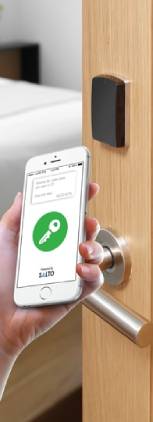
Wireless locks managed from a mobile app or web dashboard. Good for light commercial, managed properties, and remote management. Verify commercial grade rating. Brands: Schlage Encode, Yale, dormakaba.
5. Biometric (Fingerprint)
Authenticate by fingerprint. Cannot be shared like codes or cards. Pair with a backup credential (card or PIN). Check state biometric data privacy laws. Best for server rooms, pharmacies, and labs.
6. Multi-Credential Systems
Accept multiple credential types on the same door. Can require two factors for high-security areas. Enable gradual migration between technologies.
7. Networked / Cloud-Managed Access Control
Doors, controllers, and readers connected to centrally managed software. Add/remove users, set schedules, receive alarms, and pull audit reports from one dashboard. Integrates with video, alarm, elevator, and HR platforms. Best for multi-door facilities and regulated environments.
Technology Comparison Table
| Technology | Credentials | Power | Users | Best For | Price Range (per door) |
|---|---|---|---|---|---|
| Mechanical pushbutton | Button combination | None | Shared code | Storerooms, utility rooms | $150 - $500 |
| Standalone electronic keypad | PIN code | Batteries | 100 - 5,000+ | Single doors, small offices | $250 - $900 |
| Proximity / RFID card | Card, fob, smart card | Batteries or wired | Hundreds to thousands | Offices, schools, multifamily | $400 - $1,500 |
| Smart lock (Wi-Fi/BT/Z-Wave) | Mobile app, PIN, card | Batteries | Dozens to hundreds | Light commercial, managed properties | $200 - $800 |
| Biometric (fingerprint) | Fingerprint + backup | Batteries or wired | Dozens to thousands | Server rooms, labs, pharmacies | $500 - $2,000 |
| Networked / cloud (multi-credential) | Card, PIN, mobile, biometric | PoE, 12/24V, or batteries | Enterprise scale | Multi-door facilities, compliance | $800 - $3,000+ |
Brand Comparison: 7 Commercial Manufacturers
Schlage (Allegion)
ND Series (cylindrical), L Series (mortise), AD Series (networked wireless), CO Series (standalone electronic), NDE/LE (wireless networked). Grade 1 across all commercial lines.
Yale / ACCENTRA (ASSA ABLOY)
AU Series (cylindrical), 8800 Series (mortise), InTouch and nexTouch (standalone electronic and networked). Now sold under the ACCENTRA brand. Grade 1 available.
Corbin Russwin (ASSA ABLOY)
CL3300 Series (cylindrical), ML2000 Series (mortise), Access 700 (standalone electronic). Heavy-duty Grade 1 for institutional and high-abuse environments.
Sargent (ASSA ABLOY)
10 Line (cylindrical), 8200 Series (mortise), Profile Series (networked wireless). Grade 1 across all lines.
ASSA ABLOY (HES / Securitron)
HES electric strikes (1006, 5000, 9600 Series), Securitron electromagnetic locks and power supplies.
Alarm Lock / Napco
Trilogy T2 and T3 (standalone keypad), DL2700/DL3000/PDL Series, Networx (wireless networked). Strong in retrofit electronic access.
dormakaba
Simplex (mechanical pushbutton), E-Plex (standalone electronic), Saflok/Confidant (hospitality/multifamily), 710/740 Series (wireless networked).
Standalone vs. Networked Architecture
| Feature | Standalone | Networked / Cloud |
|---|---|---|
| Management | At each lock individually | Central dashboard for all doors |
| User changes | Walk to the lock | Instant from any browser or app |
| Audit trail | On-lock log, downloaded manually | Real-time, centralized, exportable |
| Schedules | Limited or none | Per-door, per-group, holiday overrides |
| Alarms | None or local buzzer | Forced entry, door held open, lockout alerts |
| Wiring | None (battery powered) | PoE, 12/24V, or wireless with hub |
| Upfront cost | Lower per door | Higher (controllers, software, wiring) |
| Ongoing cost | Batteries only | Software license + maintenance |
| Best door count | 1 - 10 doors | 5+ doors, especially multi-site |
Recommendations by Building Type
| Building Type | Recommended Technology | Key Considerations |
|---|---|---|
| Office | Standalone keypad or card access; networked for 10+ doors | Employee turnover, after-hours access, audit trails |
| School (K-12) | Networked card/fob with lockdown | Lockdown integration, visitor management, state security grants |
| Healthcare | Networked multi-credential | HIPAA audit trails, ligature-resistant hardware, pharmacy access |
| Multifamily | Smart locks or card per unit; networked for common areas | Tenant turnover, remote code management, package rooms |
| Retail | Standalone keypad for back rooms; card for POS areas | Employee shift changes, theft prevention |
| Government | Networked multi-credential with PIV/CAC | FICAM compliance, FIPS 201, HSPD-12, audit requirements |
| Industrial | Mechanical pushbutton or standalone keypad; networked for perimeter | Harsh environment ratings, glove-friendly keypads |
Key Specifications
- ANSI/BHMA Grade: Grade 1 for high-traffic commercial doors. Grade 2 for interior low-traffic. Grade 3 is residential only.
- Credential types: PIN, proximity card (125 kHz), smart card (13.56 MHz MIFARE/DESFire/SEOS), mobile (BLE/NFC), fingerprint, or combinations.
- Battery life: Standalone locks typically last 1 to 3 years on 4 AA batteries. Wi-Fi smart locks may need more frequent changes.
- Fire code: Locks on fire-rated doors must be listed for that application. Exit doors must allow free egress from inside without a credential.
- ADA: Lever trim, no tight grasping/pinching/twisting, operable with one hand, max 5 lbf. Keypads and readers at 34 to 48 inches.
- Weather: Exterior locks must handle temperature extremes, moisture, and UV. Check IP rating or manufacturer outdoor rating.
Installation Considerations
- Door preparation: Cylindrical locks use a standard 2-1/8" bore. Mortise locks need a mortise pocket. Confirm door thickness and backset.
- Handing: Many electronic locks are field-reversible. Some lever trims are handed. Confirm before ordering.
- Power: Battery standalone locks need no wiring. Wired strikes and maglocks need a 12/24 VDC power supply.
- Network: Networked locks need Ethernet/PoE, a wireless hub, or Wi-Fi at each door.
- Retrofit: Check if the new lock fits existing door prep. Card readers with electric strikes can keep the existing mechanical lockset.
- Contractor: Wired access control typically requires a licensed low-voltage contractor.
Total Cost of Ownership
| Cost Category | Standalone (per door) | Networked (per door) |
|---|---|---|
| Hardware | $250 - $900 | $800 - $3,000+ |
| Installation | $50 - $200 | $300 - $1,500 |
| Ongoing (annual) | $10 - $30 (batteries) | $50 - $300 (license + maintenance) |
Standalone locks cost less upfront but management labor increases with door count. Networked systems cost more upfront but reduce ongoing management and provide audit and compliance capabilities.
Migration Checklist: Keyed to Keyless
- Inventory all doors: type, frame, existing hardware, traffic level
- Define access groups: who needs which doors, when
- Choose technology using the tables above
- Check door prep compatibility
- Plan power and network infrastructure
- Verify fire-rating, ADA, and free egress compliance
- Order credentials (cards, fobs) for all users
- Schedule phased installation starting with main entrances
- Program users, test every door, verify audit logs
- Train users on codes/cards, lockout procedures, battery replacement
- Assign ongoing management responsibility
- Keep mechanical key override on critical doors
Frequently Asked Questions
1. What is the best keyless lock for a commercial office?
For a single door, a standalone keypad like the Alarm Lock Trilogy or Schlage CO Series. For 10+ doors, a networked card access system.
2. Do commercial keyless locks need batteries?
Mechanical pushbutton locks do not. All other standalone electronic and smart locks run on batteries (typically 4 AA, lasting 1-3 years). Wired strikes and maglocks use building power.
3. Can I replace my keyed lock without changing the door?
In most cases, yes. Many electronic cylindrical locks fit a standard bored door preparation. Check backset, thickness, and cross bore dimensions.
4. Card reader vs. card-reader lockset?
A card-reader lockset replaces the entire lock. A standalone reader mounts on the wall and controls a separate electric strike or maglock, keeping your existing mechanical lock.
5. Are keyless locks ADA compliant?
Locks with lever trim that operates without tight grasping (max 5 lbf) meet ADA requirements. Mount keypads and readers at 34-48 inches.
6. Can I use a keyless lock on a fire-rated door?
Yes, but it must be listed for fire-rated doors, allow free egress from inside, and release on fire alarm if electrified.
7. What happens if batteries die?
Most have low-battery warnings weeks before failure. Many include a mechanical key override or external battery jump contact.
8. How many codes can a standalone keypad hold?
Entry-level: about 100. Mid-range (Alarm Lock Trilogy): up to 3,000. For more users, consider networked.
9. Standalone or networked?
Standalone for 1-10 doors with stable users. Networked for 5+ doors, frequent changes, audit trails, lockdown, or multi-site management.
10. Can KAL Door Hardware help me specify a system?
Yes. Call (561) 826-6018 or email sales@keylessaccesslocks.com. We carry all brands listed here and can match the right technology to your doors and budget.
About KAL Door Hardware
KAL Door Hardware (KeylessAccessLocks.com) is a division of B&H Depot LLC specializing in keyless entry and access control products. Based in Boca Raton, Florida, operating since 2006 with 26 US warehouse locations and over 1 million products. SAM-registered (CAGE 4Q1E4, DUNS 080423290). Phone: (561) 826-6018. Also visit BandHdepot.com for the full commercial door hardware catalog.